
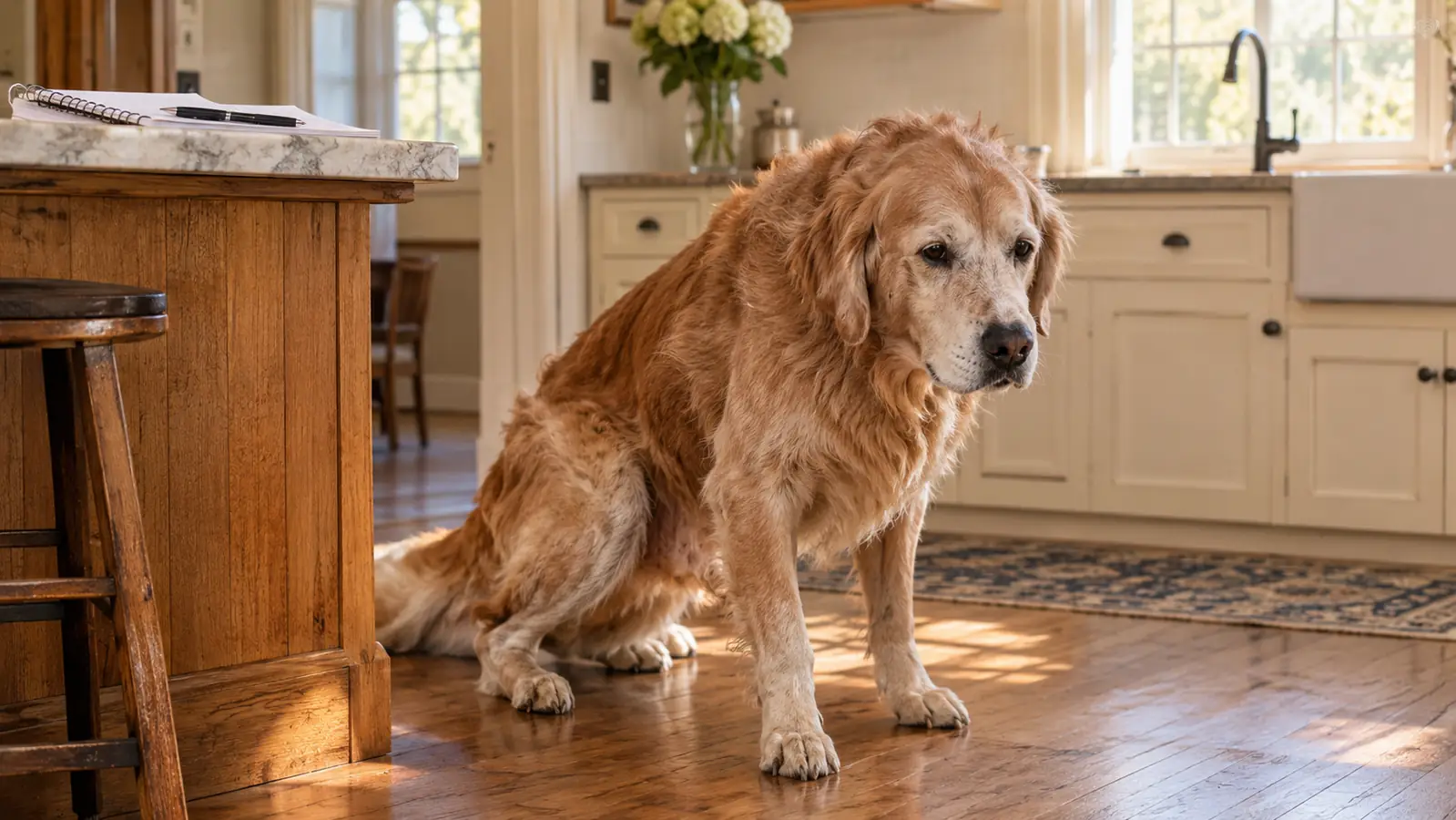
Two bottles sat on my kitchen counter for a week before I opened either one. Same yellow root on both labels. One was a tablet made for dogs and one was a capsule made for people, and neither one answered the only question I had, which was what belongs in the breakfast bowl of a 72 pound Labrador and golden retriever mix who is ten years old and stiff in both hips.
Biscuit is that dog. He had X-rays in September 2024 and Dr. Amundsen, his vet since he was a puppy, wrote arthritis in both hips on the paper, plus stiffness in the left knee. The Coco and Luna Turmeric tablets went onto his kibble in July 2025 and they have been there every morning since, about sixteen months now. The curcumin capsules never went into his bowl at all. I want that out in the open before I compare anything: I read both labels, I asked Dr. Amundsen questions, and I did not run the two side by side on my own dog.
Here is the short answer. If your dog eats breakfast from a bowl and will take a flavored tablet crumbled over the top, the Coco and Luna tablets are the easier thing to live with, and the amount on the label is written for a dog rather than for a person. If your vet has named a specific amount of curcuminoids, the concentrated part of the turmeric root, then a curcumin capsule is the tool for that job. A capsule can hold an extract standardized to a known percentage. A tablet of ground root cannot. Practicality points one way and precision points the other, so the honest answer depends on which of those two problems you are actually trying to solve.
| Coco and Luna Turmeric | Curcumin capsules | |
|---|---|---|
| Form | Bacon and liver flavored tablet, 120 count | Plain capsule, no flavor, usually sold for people |
| Curcumin strength | Ground turmeric root, curcumin is only a fraction of the powder | Extract standardized to a stated curcuminoid percentage |
| Absorption pairing | BioPerine, a black pepper extract, is already in the formula | Depends on the maker, many have nothing added |
| Getting it into a dog | Hand it, or crumble it over kibble | Open the capsule and dust it, or pill it, and the powder is bitter |
| Dose written for a dog | The label gives the amount for a dog's weight | The label gives a human amount, so your vet does the math |
| Single ingredient option | A flavored tablet with a binder in it | Can be one ingredient and nothing else, useful for a sensitive stomach |
| Ingredient watch list | Veterinarian formulated, free from palm oil and corn | Varies by maker, read every label |
| Best for | A dog already eating breakfast from a bowl every morning | A vet-directed plan that calls for a set curcuminoid amount |
Where Coco and Luna Wins
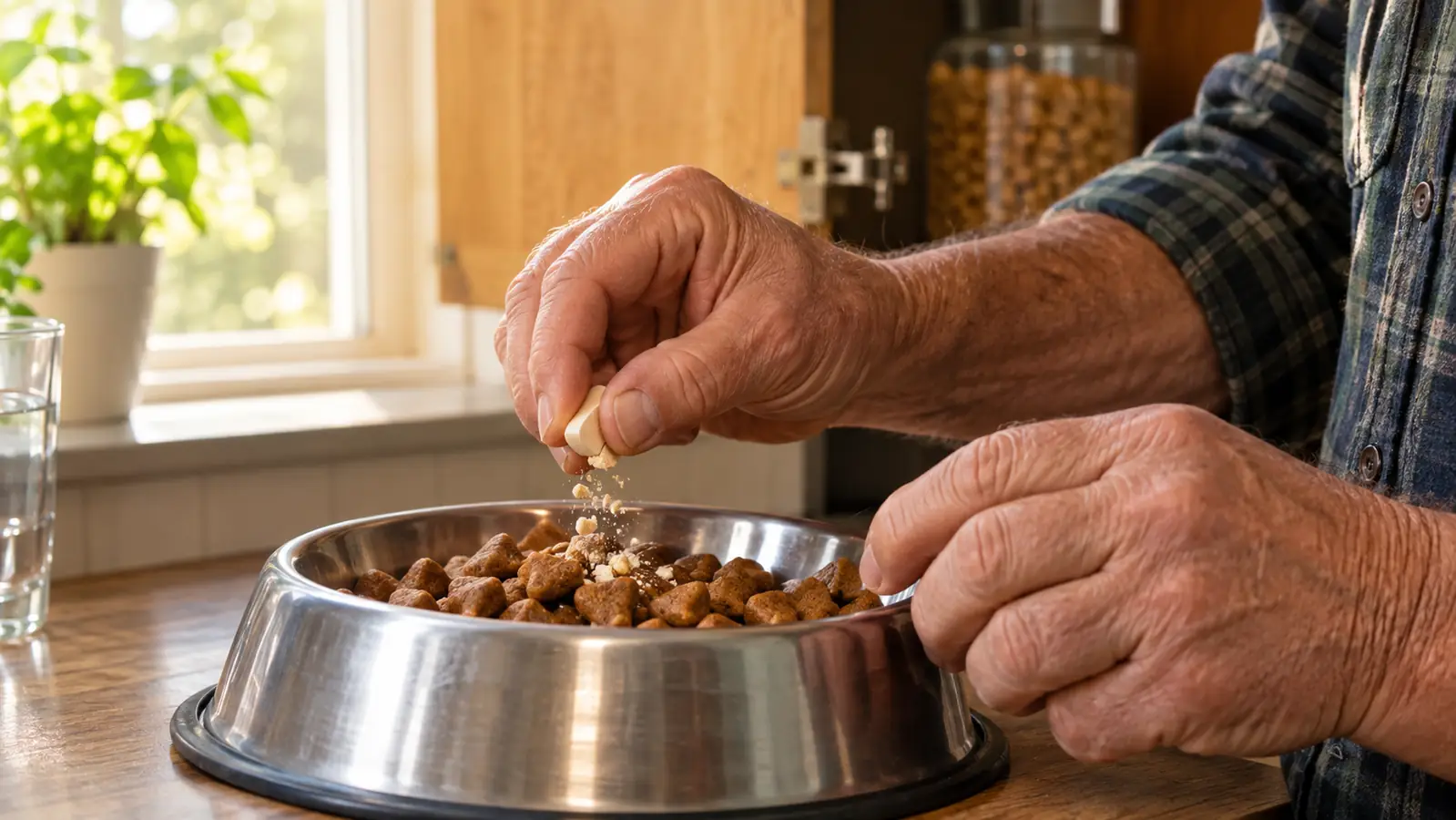
Start with the thing that decides it in most houses: actually getting it into the dog. In his first week on Cosequin, Biscuit took a tablet from my hand, worked it to the side of his mouth and spat it onto the floor. Everything since has gone on the kibble and that has not changed. The turmeric tablet crumbles between my thumb and forefinger, and I scatter it over his breakfast the way I would salt a pan of potatoes. He is on five things now and he has never once picked this one out.
Second, the black pepper piece is built in. The active ingredients on the label are turmeric root and BioPerine, which is a black pepper extract, and that pairing is the reason people talk about turmeric at all rather than just spooning the kitchen spice into a bowl. If I had gone the capsule route I would have had to check every bottle for it, because plenty of them are curcumin and nothing else. Third, this one is veterinarian formulated, and the label lists no palm oil and no corn, which were the two things Dr. Amundsen asked me to look for after she read it. Fourth, and this is not small, the label gives the amount for a dog's weight. I did not have to do arithmetic in the kitchen or convert anything down from a human serving at seven in the morning.
One more practical thing, and it is the reason I stopped looking at soft chews in the first place. In August the kitchen gets hot enough that a soft chew turns tacky in the tub and the pieces fuse together, and you end up chiseling one loose with a butter knife. A tablet does not do that. The bottle sits in the cupboard left of the stove next to the Cosequin, and on the mornings I am at a school concert or a ball game, Glen does breakfast and crumbles it the same way. He does not measure and he does not count, he takes the label's amount for his weight, and the dog cleans the bowl either way.
Where Curcumin Capsules Win
None of that makes capsules the lesser choice. It makes them a different tool. Turmeric root powder is the whole root, ground, and curcumin is only a slice of what is in it. A capsule can carry an extract standardized to a stated percentage of curcuminoids, so if Dr. Amundsen had said she wanted a particular amount of curcumin in him, the capsule would have been the only way to get anywhere near it. You cannot hit a target number with a spoonful of ground root, no matter how carefully you scoop.
The second honest point is the ingredient list. A good curcumin capsule can be one thing and one thing only. For a dog with a touchy stomach, or one on a prescription diet where every addition gets questioned, a plain capsule that can be opened and measured starts cleaner than a flavored tablet with a binder in it. I have never put one in Biscuit's bowl, so I cannot tell you how he would take the taste. I can tell you that I have read enough labels to know the powder is bitter, and that most people end up hiding it in something, which is its own small project every morning.
I did the aisle research anyway. I stood in the feed store with three capsule bottles in my hands and turned each one around. One listed a curcuminoid percentage in bold and nothing else in the formula. One listed the percentage and then a paragraph of other ingredients I did not recognize. One listed no percentage at all, which tells you very little about how much of the active thing you are actually getting. That is not a knock on capsules. It is the reason a capsule purchase is a reading job and a tablet purchase is closer to a grab and go.
The One That Goes on the Kibble Instead of Into a Negotiation
Bacon and liver tablet, turmeric root with BioPerine, veterinarian formulated and free from palm oil and corn. It is the one Biscuit has taken for sixteen months without once spitting it back out.
Amazon Check Today's Price on Amazon →How I Read the Two Labels
The Coco and Luna bottle is 115 grams, about 4 ounces, and holds 120 tablets. Bacon and liver is the flavor on the label, and the tablet form matters more than people expect, because a soft chew in a hot kitchen in August turns into one solid mass in the bottom of the tub. The active ingredients listed are turmeric root, Curcuma longa, and BioPerine. The benefits line says joint health, mobility support and skin care, and the uses line mentions hips and joints, which is the whole reason I was standing in that aisle in the first place.
The bottle itself is small, 4.53 by 2.2 by 2.2 inches and about 4 ounces, which sounds like a footnote until you are the one fitting five bottles behind one cupboard door. It stands upright on the shelf left of the stove beside the Cosequin and the mussel bites, and I can put a hand on it without looking. The 120 count is the number I actually watch, because running out on a Tuesday means four or five mornings of a plain bowl before a reorder lands, and those are the mornings the log goes blank.
Capsule labels are a different read entirely. They are mostly written for people, so the serving is for an adult and the percentage of curcuminoids is right there in bold type. That is useful information. It also puts the arithmetic on you and your vet: how much does a 72 pound dog need, how does that divide into what is inside one capsule, and do you want to be cracking capsules open over a bowl every morning before your own coffee.
The test I settled on, and the one I would hand to anyone, is three questions. Is the amount on the label written for a dog's weight. Is there anything in it that your vet has told you to avoid, which for us was corn and palm oil. And will your dog actually take it without a negotiation at seven in the morning. Everything past those three is a conversation for the vet who has seen your dog's X-rays, not for a stranger on the internet, and I include myself in that.
Sixteen months, one tablet crumbled over the kibble each morning, and not one morning where he turned his nose up at it.

What Sixteen Months in the Log Actually Showed
I keep a practice log. It is the same kind of paper log I used to hand to students, and it lives on the kitchen counter with a pen clipped to it. One line a day: how he got up, how the stairs went, how far we walked. That log is the only reason I can say anything at all about this with a straight face, because memory is a liar when you are hoping something worked.
Take one day as an example, a wet Tuesday in November 2025. The line reads: up slow, back legs first, then a pause. Down the back steps fine. Twenty minutes, cut short by rain. That is a bad weather day and we still have them. Put it beside a line from the same log thirteen months earlier, September 2024: up in stages, needed the doorframe, fifteen minutes and he turned for home at the mailbox. Same dog, same road, same woman on the other end of the leash. The difference is real and it is modest, and I am not going to dress it up as anything more than that.
The turmeric went in during July 2025. By the first cold mornings that fall I thought he loosened up a little faster getting off the kitchen floor, and I wrote that down, and then I wrote down that I could not be sure. He had no stomach trouble on it, which mattered at ten years old, and it did not change his appetite or his stools. That is the whole of what I can honestly report about it, and I would rather hand you a small true thing than a big one I cannot stand behind.
The rest of the story is not tidy. He takes five things, all on breakfast at seven, added months apart so the log had a chance to say something. Because they overlap, I cannot prove which one did what and I will not pretend otherwise. What I can tell you is what changed overall. Walks went from about fifteen minutes in September 2024 to about twenty five by the summer of 2025 and have held there since. He gets up easier than he did. He comes down the thirteen indoor stairs steadily and is still slow going up. Cold, wet days are still his worst. He is not cured, he did not get young again, and no bottle on that shelf ever told me otherwise.
Who Should Buy Which
Buy the Coco and Luna tablets if your dog already eats from a bowl every morning and you want one more thing to put on top of the kibble. Buy them if your dog is a tablet spitter, since crumbling is the entire point. Buy them if you would rather not do arithmetic and a label dose written for a dog's weight sounds like a relief. And buy them if a flavored tablet with BioPerine already inside means you are not out buying a second bottle of something to help absorption.
Buy curcumin capsules if your vet has named an amount. Buy them if your dog cannot have a flavored tablet or a binder, or if you want a single ingredient you can open and measure yourself. I would not buy either one without the other half of the sentence, which is a call to your own vet. Dr. Amundsen read every label before Biscuit started anything, and she is the reason this is a comparison rather than a recommendation. Supplements support a joint. They do not treat arthritis, they do not replace whatever your vet has planned, and results vary from dog to dog in a way no label can promise you.
If Your Dog Is Already at the Bowl, This Is the Smallest Addition
120 tablets, turmeric root with BioPerine, the amount for his weight printed on the label. Ask your vet first, then add one thing at a time and write down what you see.
Amazon Check Today's Price on Amazon →