
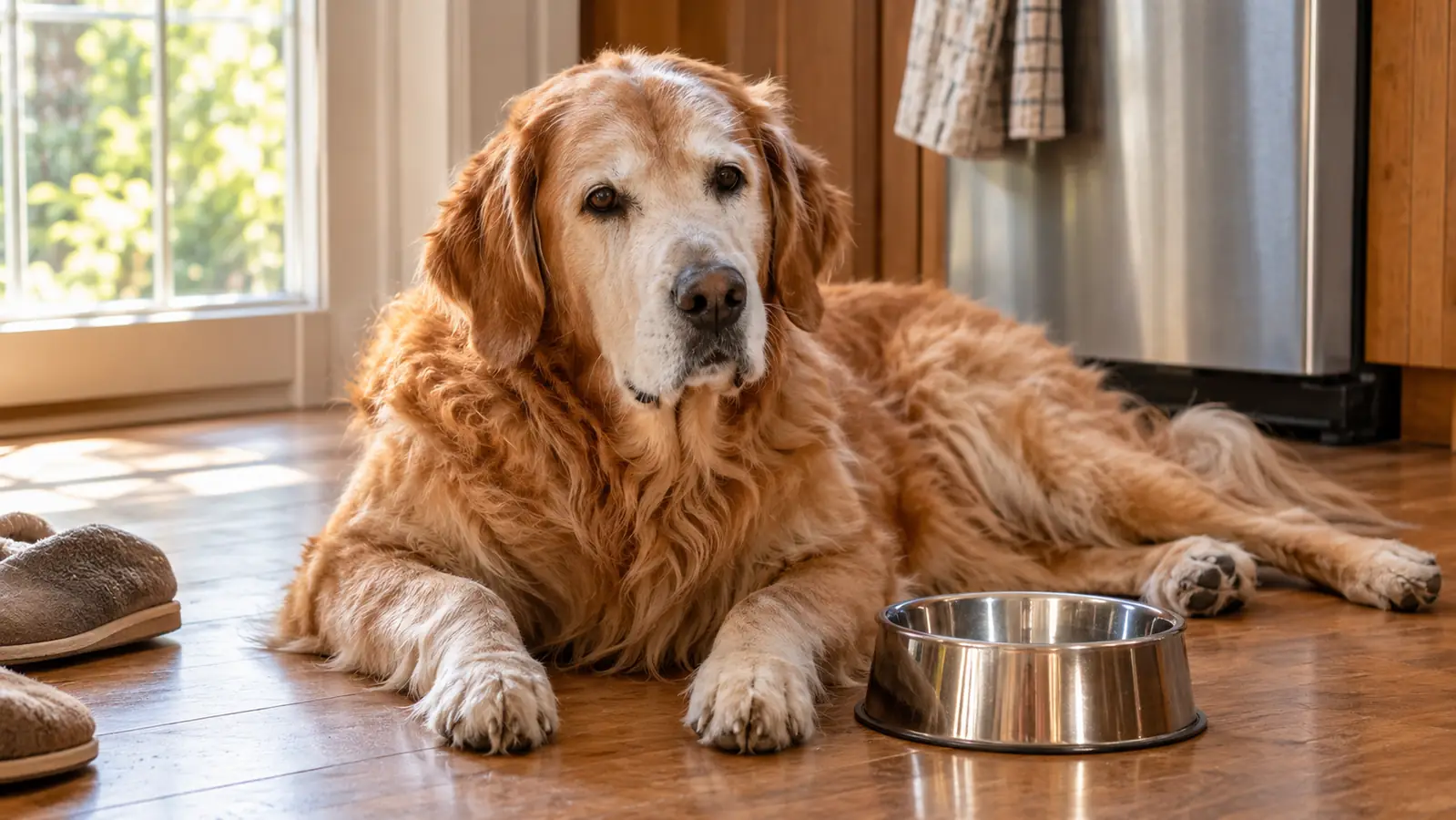
Biscuit did not come up lame. There was no morning when he refused the stairs and I called the vet in a panic. What happened was quieter than that. Through the fall of 2024 he began pausing at the bottom of the four wooden back steps, the way a person pauses at the edge of cold water, and then he would go up anyway, slower than the week before. At his September 2024 visit, Dr. Amundsen put the X-rays up and showed us arthritis in both hips and some stiffness in his left knee. He weighed 72 pounds that day. She did not hand us a prescription. She asked us to hold his weight where it was, keep him moving every day, and add one supplement at a time so we could actually tell what did what. Nordic Naturals Omega-3 Pet was the second thing we added, in January 2025, and the bottle is still in our refrigerator door today.
What follows is not the supplement aisle answer. It is the kitchen answer, the one that gets repeated at 7 o'clock every morning whether or not anybody feels like it. Five steps in the order that worked for us, then what else helped, then the part where I tell you plainly what I did and did not see. Take all of it to your own vet before you take it to your dog.
The Bottle That Has Lived in Our Fridge Door Since January 2025
Nordic Naturals Omega-3 Pet is an unflavored liquid fish oil, 1380 mg, in an 8 ounce bottle. It goes on top of Biscuit's kibble at breakfast and nowhere else. If your vet has already said fish oil is fine for your dog, this is the one we have used for 22 months.
Amazon Check Today's Price on Amazon →Step 1: Get Your Vet's Yes First, and Bring the Label, Not the Name
Dr. Amundsen has seen Biscuit since he was a puppy, and she read the label on every one of the five things that now go into his bowl. Not the name on the front of the bottle. The label. She is the one who pointed out that a dog his age, with his hips, is a dog whose weight and kidneys and everything else he takes all get a vote, and that the time to find that out is before you have opened anything. So the first step is a question tacked onto a regular visit, or a phone call, or a photograph of the back of the bottle sent to her office.
The second half of this step is the harder half. Add one thing. Not four. We started Cosequin chewable tablets in October 2024 because she suggested them, and we did not add anything else until January 2025, then April, then July, then November. Months apart, each one given room to show something in the log. When people tell me nothing works, what they usually mean is they started three bottles in the same week and cannot tell which one helped or which one turned their dog off his dinner. You only get to make that mistake once with a dog this age, so do it slowly the first time.
Step 2: Measure by the Label's Amount for His Weight, Not by Eye
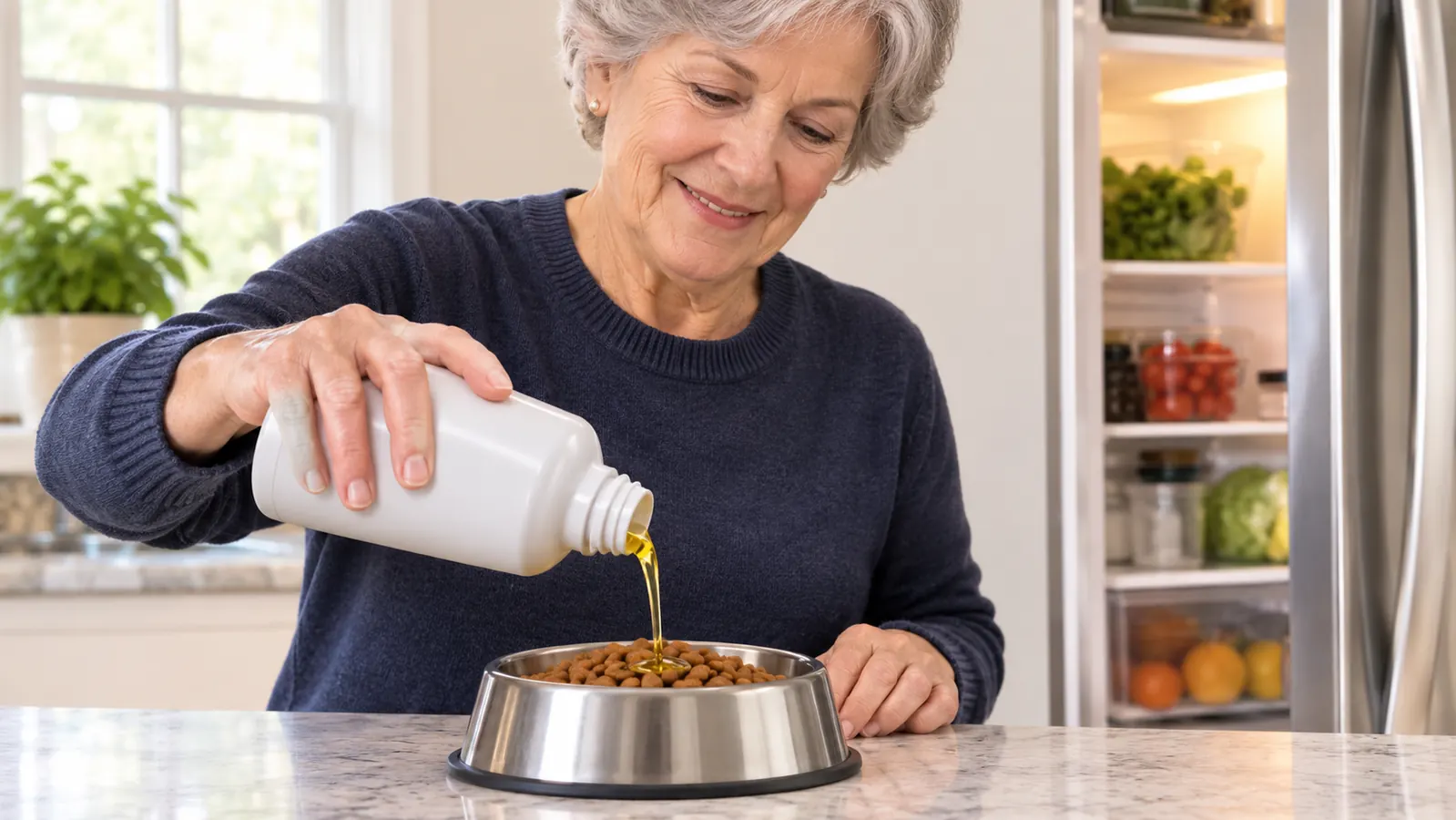
The Nordic Naturals bottle gives an amount by weight, and I use the label's amount for his 72 pounds. I do not round up on a cold morning when he is stiff, and I do not skip a day and double the next one to make up for it. Fish oil is a fat. It moves through a dog the way fat does, and more is not better, it is just more. If your dog is smaller or larger than Biscuit, the number on the label changes and the number in your head should not.
What is in the bottle matters for this step too. It is 1380 mg of fish oil with EPA and DHA, in liquid form, unflavored, and Nordic Naturals makes it in the triglyceride molecular form, which is the form the fat naturally takes in fish. I am not a chemist and I cannot tell you what that does under a microscope. I can tell you Dr. Amundsen read it and said yes, and that a bottle goes a good while at the label's amount, which is the arithmetic that matters when you are the one doing the buying.
Step 3: Put It on Breakfast and Keep It There
Breakfast is at 7 in our house and dinner is at 5, and the fish oil goes on breakfast. Every one of the five things goes on breakfast, in order, over plain dry kibble. Nothing goes on dinner. That is not because dinner is the lesser meal. It is because a routine that happens twice a day has twice as many chances to be forgotten, and a dog does not remind you, he just waits.
Biscuit eats nearly anything out of a bowl, but in the first week of the Cosequin he took the tablet from my hand, walked three steps, and spat it on the rug. So everything since then has gone on the kibble. The liquid is the easiest of the lot because unflavored fish oil simply soaks in and disappears. He does not care about it at all. Glen cares. The bottle smells like exactly what it is, and that refrigerator door has smelled like a fish market since January 2025.
One thing I would not do: do not pour it into the bag of kibble. I know it seems efficient. It is not, because you cannot control how much lands in any one bowl, and the last meal in the bag is either swimming in it or has none. Pour it over the top of the bowl, set the bowl down, and be done.

Step 4: Once It Is Open, It Lives in the Refrigerator Door
The bottle goes into the refrigerator door the moment the seal is broken, and it does not go back into the cupboard. Ours is an 8 ounce bottle, 237 ml, and it takes up a spot in the door that nothing else wanted. This is the step people skip, and it is the one I would not skip. If it sits on a shelf by the stove for two months, you are not giving your dog what the label promised.
Two notes for down here. The label lists fish as an allergen, which sounds foolish on a fish oil bottle until you have a dog who reacts to fish, and then it stops sounding foolish. And the listing says non-GMO, gluten and dairy free, with no artificial colors, flavors or preservatives, which matters less to Biscuit than it does to me, but it is the reason I stopped reading the back of every other bottle in that aisle.
Step 5: Keep One Line a Day for Eight Weeks Before You Decide Anything
I kept a practice log for thirty years, the same kind I used to hand a student so she could see that the scale she was certain had not moved had in fact moved. It turns out a dog benefits from the same courtesy. Ours sits on the kitchen counter and it gets one line a day: how he got up, how the stairs went, how far we walked. That is all. No ratings out of ten, no adjectives, no guessing at how he seemed.
Here is what that log says about fish oil, and I will be straight with you because you are the one who has to decide. I never saw a joint change I could point to. His getting up did not improve in any way I could separate from everything else going on in that bowl. What changed at about eight weeks was his coat, softer and less flaky along his back, which was not the thing I was hoping for but is a real thing all the same. I keep buying it because Dr. Amundsen recommended it, because there has not been one bad reaction in 22 months, and because a dog with arthritis is a dog I want every advantage for, including the ones I cannot see from the doorway.
Eight weeks is not an arbitrary number I picked out of the air. Six weeks is when the log first showed something from the Cosequin, and roughly six when the mussel bites stopped him lagging on the last stretch of the walk. If nothing at all has changed in eight weeks, you have your answer and you can stop paying for it. What you cannot do is decide on day four, when the only thing you have learned is that your dog still has arthritis.
What Else Helps
The things that helped most in this house cost the least. Weight first. Dr. Amundsen asked us to keep him under 75 pounds and he has sat at 72 the whole time, which is one fewer thing his hips have to argue with. Walks second. He was doing about 40 minutes years ago, down to about 15 by September 2024, and back to about 25 by the summer of 2025, where he has stayed. Short and often beat one long outing, and a slow sniffing walk on the flat is worth more to him than a fast one.
Floors third. We put rubber-backed runners down the hallway hardwood in 2024 and they have not come up since, because a dog who is careful on wood is a dog who is bracing, and bracing is work. He does the 13 indoor stairs down steadily now and still goes up slowly. On cold, wet days he is worse and there is no supplement that changes the weather. Since 2024 Glen lifts his back end into the Subaru Outback with the seats down, because Biscuit stopped jumping in on his own and did not start again.
And the honest frame around all of it: supplements support a joint that is already worn. They do not treat arthritis, they do not cure it, and the difference between a supported dog and an unsupported one is a small difference you measure in a log, not a big one you notice from across the yard. Your vet is the one who knows your dog's kidneys, his weight and his other medications. I am just the woman with the paper log on the counter.
Eight weeks in, the line that had changed in the log was not about his hips. It was about his coat: softer, and the flaking along his back gone.
If Your Vet Has Already Said Yes to Fish Oil, This Is the Bottle We Have Used for 22 Months
Unflavored liquid, 1380 mg with EPA and DHA, an 8 ounce bottle that lives in our refrigerator door and goes on breakfast kibble at the label's amount for his weight. It did not fix Biscuit's hips. It is still on the counter every morning.
Amazon Check Today's Price on Amazon →