

Biscuit is ten, seventy-two pounds, and built like a coffee table with a tail. He is a yellow Lab and golden retriever mix, and in September 2024 his X-rays showed arthritis in both hips and a stiff left knee. He will also not take anything from my hand. The first joint tablet I ever offered him, he held in his mouth for a second, gave it some thought, and then set it down on the kitchen floor and walked off. That was the end of hand-feeding in this house.
So everything he gets arrives on top of his kibble at seven in the morning. That includes the green lipped mussel soft chew from Zesty Paws that has been part of the morning since April 2025, along with four other things added months apart. Getting a picky senior dog to take a joint chew is not difficult. It is a small number of decisions made in a specific order, and most people make them out of order and then decide the chew did not work. Here is the order that worked here.
The Chew That Goes On The Kibble, Not In Your Hand
Zesty Paws Mussel Mobility Bites are chicken and mussel flavored soft chews made with New Zealand green lipped mussel, and they pull apart with a thumb, which is the entire reason they work in this house. 4.5 stars across about 2,790 reviews. Ask your vet before you start anything, then check today's price.
Amazon Check Today's Price on Amazon →Step 1: Have Your Vet Read The Label Before You Buy Anything
Dr. Amundsen has been Biscuit's vet since he was a puppy. She does not sell supplements and she has never pushed one, but she reads labels, and she read every one of them before he started. That is the first step and it is not a formality. A ten year old dog may already be on something, and a supplement label is a legal document the same way a cereal box is, which means it is worth having someone who reads them for a living look at the one you are holding.
What she wanted to see was simple. Is the green lipped mussel actually listed as an ingredient, not just hinted at in the product name. Is the form something the dog will accept, a tablet or a soft chew. Does the label give an amount by weight so you are not guessing at the kitchen counter. The Zesty Paws package lists New Zealand as the source of the mussel, the bites are soft chews rather than tablets, and the label gives an amount by weight. That mattered to us. The form would not have mattered to her. It mattered to Biscuit.
She also said the sentence I now repeat to everyone at the ball field. Supplements support joints. They do not treat arthritis, they do not cure anything, and they will not make your dog young. If your dog is yelping, holding a leg up, or refusing to stand, that is a different phone call and it is not a chew. There is no version of this where you skip the phone call.
Step 2: Measure By The Label, Not By The Size Of The Chew
Every package has a chart by weight, and seventy-two pounds lands Biscuit in the same row it has landed him in since 2024. I give the label's amount for his weight. I do not give a little extra because he is a big dog, and I do not cut it back because he is older. Two reasons. The label amount is the only amount anybody has actually tested, and a big dog is not a big dose. I have watched people at the dog park make that second assumption out loud, and they were always the ones with the largest dog and the smallest scoop.
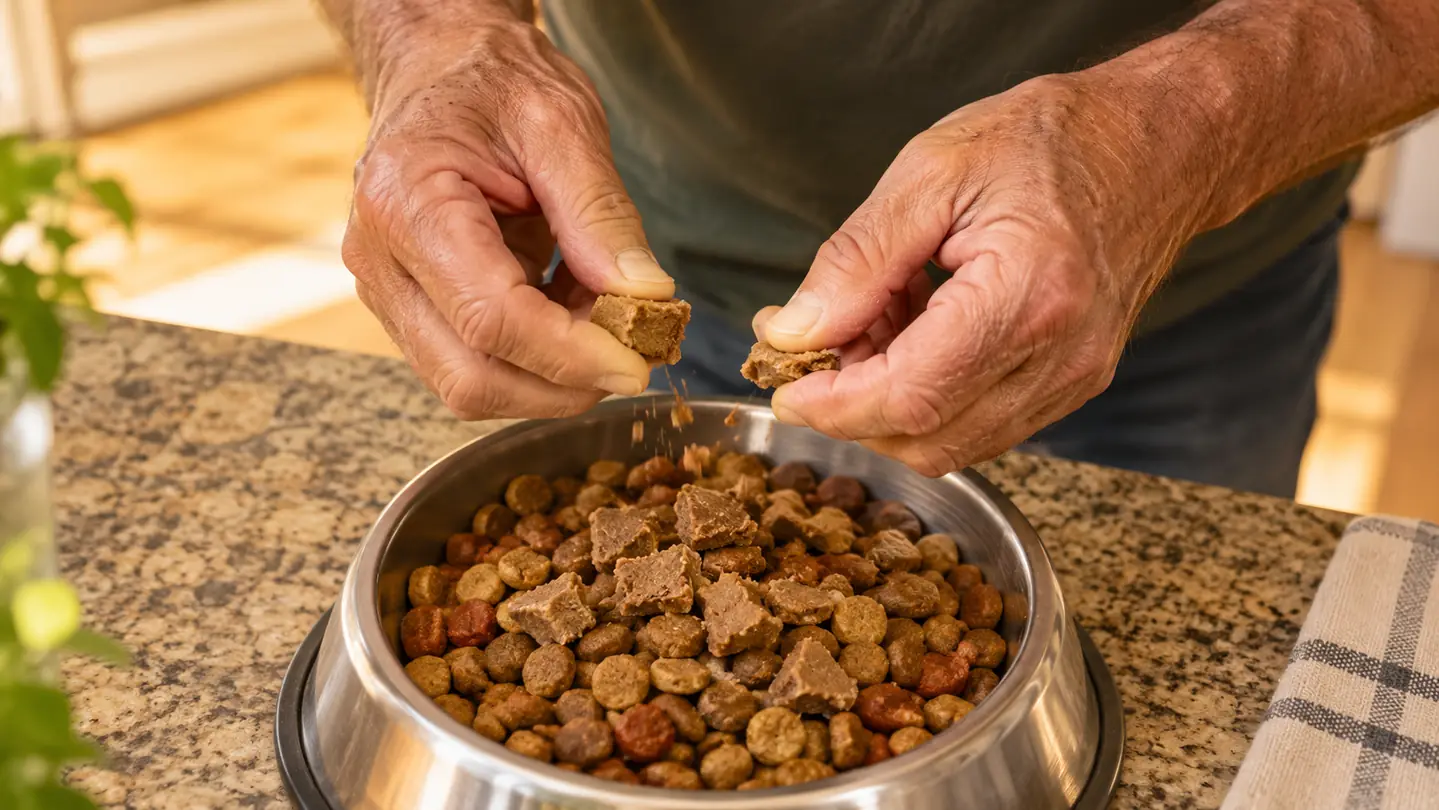
The other thing I do is break it up. The Zesty Paws bites are soft enough to pull apart with a thumb, and with a suspicious dog the shape matters more than the taste. A whole chew gets inspected and then dropped on the floor. Broken into pieces and scattered on top of kibble, it disappears in the general excitement of breakfast. The package is 7.9 ounces and it lives in the cupboard to the left of the stove, in the same spot as everything else in the rotation.
Do not float it in a bowl of water and do not hide it inside a piece of cheese the first time. If your dog is the type to chew around a surprise, cheese is a test he can fail, and once he fails it he learns to be careful with cheese too. On the kibble is simpler and it does not cost you a food he already trusts. The two cats in this house are unimpressed by all of it and are not part of this. Nothing here is meant for a cat.
Step 3: Put It In The Bowl, On Top Of Breakfast, Every Single Day
This was the change that fixed our problem, and it was not my idea, it was an accident of the first week. Biscuit eats plain dry kibble at seven and again at five. Everything he takes now goes on the seven o'clock bowl and nothing at dinner. Nothing comes from a hand, nothing arrives as a treat after a walk, nothing is offered at the back door as a reward for coming in.
Two things come out of that. The first is that a dog who has already refused something from your fingers has no reason to refuse it in a bowl, because a bowl is where food happens and hands are where negotiation happens. The second is the log. If everything lands at one meal, a change in behavior points at that meal. Feed one chew at breakfast and another at dinner and you have built yourself a puzzle you will not be able to solve.
It also has to survive the other person in the house. Glen does breakfast when I am out, and he does it the same way, everything on top, same order, nothing extra. If your household has two people and one of them is generous with the treats, that is worth a conversation before you start rather than after. A supplement given four days a week and improvised the other three is not really being given, and you will be reading a log that means nothing.

Step 4: Add One Thing At A Time, Months Apart, And Write It Down
I keep a paper log on the kitchen counter, the same kind of practice log I used to hand to middle school students. One line a day. How he got up in the morning. How the stairs went. How far we walked. That is it, three things, and it takes about fifteen seconds with a pencil.
The reason for the log is that memory is a poor witness when you want something to be working. I started the Cosequin in October 2024. Fish oil followed in January 2025, the Zesty Paws Mussel Mobility Bites in April 2025, a turmeric tablet in July 2025, and a hyaluronic acid liquid in November 2025. All five are still in the rotation today and none of them was ever stopped to test it. That means I cannot prove which one did what, and I am not going to stand here and pretend otherwise.
What the log can do is give you a date. The mussel bites went in during April 2025, and about six weeks later the entries changed in one specific way. He stopped lagging on the last stretch of the walk. Same route, same length, and the last five minutes stopped being a negotiation. That is modest. It is also exactly the sort of thing you will invent in your head if you are not writing it down, and inventing it feels identical from the inside.
Step 5: Judge It At Six Weeks, Not At Six Days
Six weeks is the number in this house because that is when the first thing showed up on paper. Nothing happened in the first week of anything, and if you had asked me on day four I would have told you confidently that all of it was doing nothing at all.
What I watch for is boring. The first two steps out of a down position. The bottom of the thirteen indoor stairs, and separately the top, because those are two different problems. The last five minutes of the walk. Biscuit is steady coming down now and still slow going up, and that was true before the mussel bites and is still true after them. Cold, wet mornings remain his worst, and no chew on the shelf has changed that.
What I do not watch for is running and jumping. He stopped jumping into the back of the Outback during 2024 and he has not started again. Glen lifts his back end in. Nothing in the cupboard changed that, and if you are buying a joint chew hoping for it, you will be disappointed no matter which one you pick. If nothing has changed at six weeks, that is worth telling your vet. It is not a reason to double the amount.
What Else Helps
Dr. Amundsen asked us to keep him under seventy-five pounds and he has stayed at seventy-two, and I would put that ahead of any chew on the shelf. Every extra pound is a pound resting on two arthritic hips. If your dog is carrying weight, that conversation is worth having before you spend anything on a supplement, and it is the cheaper conversation of the two.
We put rubber-backed runners down the hallway hardwood in 2024 and they have stayed down. The four wooden back steps got their edge sanded. The walk sits at about twenty-five minutes and has held there since the summer of 2025, and the first five minutes of it are slow on purpose. Cold, wet days shorten it. None of that is a product and all of it shows up in the log.
Dr. Amundsen gets a list of everything at every visit, five items on one index card, and she reads the card. She has not objected to anything on it and she has not promised anything either. If your vet wants to drop something to see what it was doing, do that with them and not on a hunch. And go in for the things that come on overnight, a limp, a foot held up, a dog who will not settle. Those are not chew problems.
Six weeks in, the log shows one thing: he stopped lagging on the last stretch of the walk. Modest, and real, and I would have missed it without the paper.
That is the whole method. Vet first, label amount, breakfast bowl, one thing at a time, six weeks. None of it is clever and none of it is fast. All of it is the difference between a joint chew that gets a fair chance and one that ends up on the kitchen floor, which is exactly where the first tablet I ever offered him ended up.
Green Lipped Mussel, In A Soft Chew He Will Actually Take
Zesty Paws Mussel Mobility Bites are chicken and mussel flavored soft chews, 7.9 ounces to a package, made with New Zealand green lipped mussel and rated 4.5 stars across roughly 2,790 reviews. Get your vet's blessing, use the label's amount for your dog's weight, and let the paper log do the judging.
Amazon Check Today's Price on Amazon →