
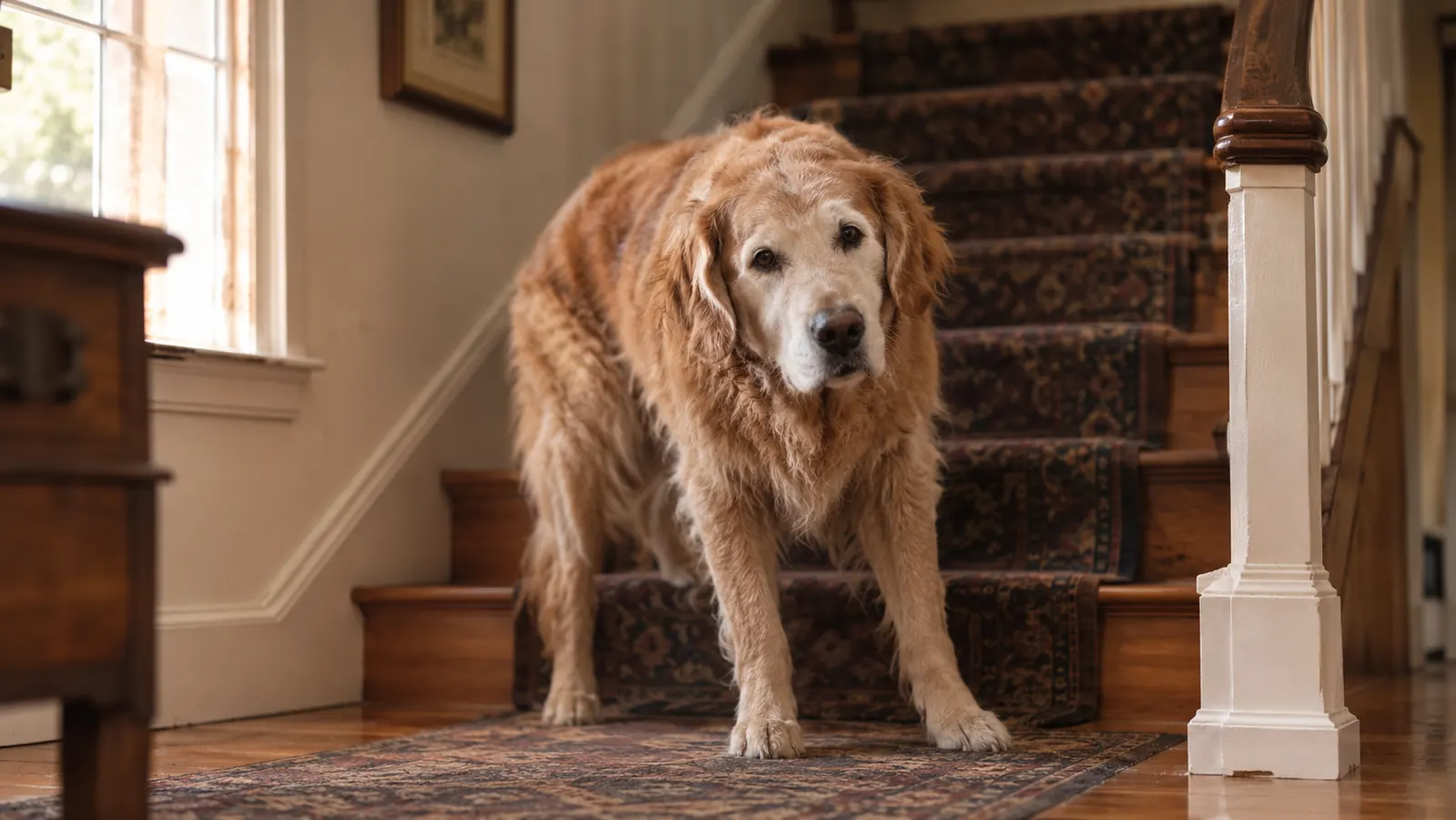
Biscuit is a 72 pound yellow Lab and golden retriever mix, 10 years old this year. By September of 2024 the thirteen indoor stairs in our farmhouse had turned into a daily negotiation. He would stand at the top, look down, look back at me, and take a long breath before he started. The X-rays that month showed arthritis in both hips and stiffness in the left knee. Dr. Amundsen, who has been his vet since he was a puppy, suggested we begin with a glucosamine and chondroitin tablet and keep track of what changed. Tracking is the one thing I know how to do. I spent thirty years as a middle school band director and handed out practice logs to eleven year olds for a living, so Biscuit got a log too, a paper notebook on the kitchen counter, one line a day. Lubrisyn HA came into that notebook about thirteen months later, in November of 2025, when he was already on four other things and I had nearly decided not to add a fifth.
The short answer, for a large senior dog who is stiff in the hips and careful on the stairs, is that these two do different jobs and the order matters more than the head-to-head. Liquid glucosamine is a cartilage building block with a long history of use in dogs, and it is where most vets start, including ours. Lubrisyn is hyaluronic acid, aimed at the synovial fluid that cushions the joint, and it is the sort of thing you add after the first one has done what it is going to do. If your dog has never taken a joint supplement, start with glucosamine. If your dog has been on glucosamine for months and is still hesitating at the top of the stairs, that is the exact gap I was standing in when I bought the Lubrisyn.
| Lubrisyn HA | Liquid glucosamine | |
|---|---|---|
| Main ingredient | Hyaluronic acid, high molecular weight | Glucosamine, usually hydrochloride or sulfate |
| What it works on | Synovial fluid, the cushion inside the joint | Cartilage, the surface the joint moves on |
| Research in dogs | Thinner, much of it drawn from horses and from people | Decades of use and more published work in dogs |
| Other ingredients in the bottle | Hyaluronic acid alone | Often bundled with chondroitin, MSM or green lipped mussel |
| Label transparency | Made in the USA in a GMP certified facility, vegan, gluten free, BPA free | Varies by brand, some list little beyond the ingredient panel |
| Which animals the label covers | Cats, dogs and horses | Usually dogs only |
| Time before my log moved | About five weeks | About six weeks, on the tablet we used |
| Fit with an existing supplement stack | Adds one more liquid and overlaps with nothing else in the bowl | Can double up if your dog already gets chondroitin or MSM separately |
| Best for | A dog already on glucosamine that is still careful on stairs | A dog who has never taken a joint supplement |
Two Different Jobs in the Same Joint
Hyaluronic acid is not a drug, and it is not a building block in the way glucosamine is. It is a molecule the body makes on its own, and in a joint it turns up in synovial fluid, the slick material that lets two bone ends move past each other instead of into each other. The case for giving it by mouth is that it supports the volume and quality of that fluid. Glucosamine does something else. It is a component the body uses in cartilage, the surface the joint actually moves on. Cushion and surface. Neither one is the whole joint, and neither one treats arthritis, which is why I have never once written the word cured in that notebook.
I am not a veterinarian and I am not going to pretend to read the literature for you. What I can tell you is how Dr. Amundsen framed it when I asked, sitting in an exam room with Biscuit's X-rays up on the screen. The research behind glucosamine in dogs is older and wider. The research behind oral hyaluronic acid is thinner, much of it drawn from horses and from people, and she was candid about that. She was still willing to let us try it, because it amounts to one more liquid on the kibble, he had tolerated everything else without a bit of stomach trouble, and the downside was small.
That is roughly where the honest version of this comparison sits. Glucosamine has more to stand on. Hyaluronic acid does a job glucosamine does not do. If you are choosing one, choose based on which job your dog actually needs and on what your vet says about your dog, not on which bottle has the louder label.
Where Lubrisyn Wins
The first place it wins is the reason I bought it: the cushion. Biscuit's X-rays show arthritis in both hips, and a hip is a joint where the fluid matters as much as the surfaces do. Once he was on a glucosamine tablet, a green lipped mussel chew, a turmeric tablet and fish oil, the question stopped being whether he was getting a joint supplement and started being whether anything in that bowl was addressing the fluid side. Nothing was. Lubrisyn was. That is a narrow claim and I am going to leave it narrow, because it is the only version of it I can defend.
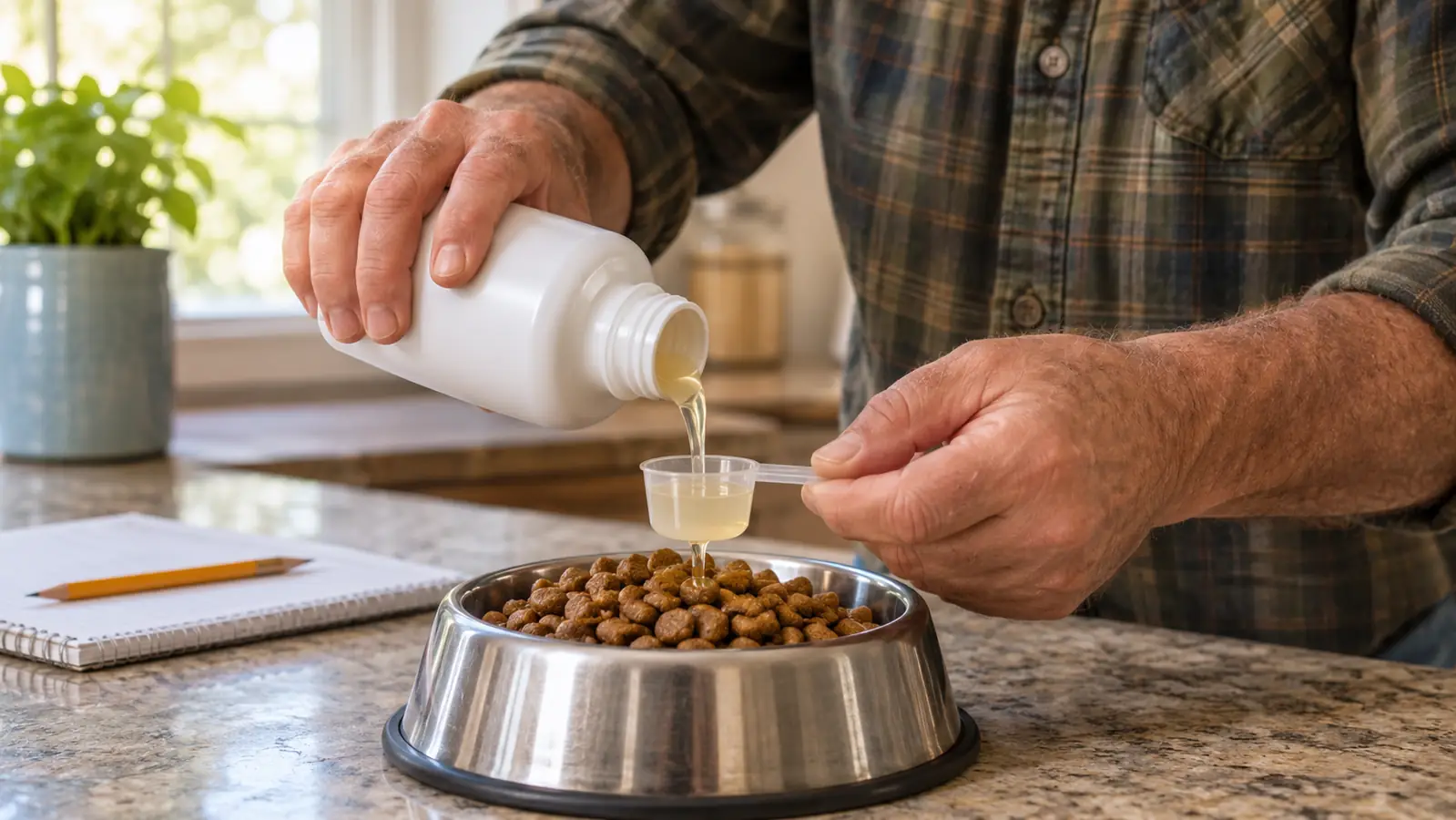
The second place it wins is transparency on the label, which matters more to me at 62 than it would have at 40. The bottle says what is in it and where it is made: a US facility, GMP certified, vegan, gluten free, BPA free, no stack of extra ingredients hidden behind the hyaluronic acid. When I handed it to Dr. Amundsen she read it in about ninety seconds and said fine. I have handed her labels she took much longer over. And practically, it is a liquid. It goes on the kibble at seven in the morning with everything else, Glen can measure it out when I am out, and in twelve months Biscuit has never walked away from the bowl or turned his nose up at it.
Where Liquid Glucosamine Wins
The research. I will not dress it up. Glucosamine has been given to dogs for decades, there is more published work behind it, and it is the first thing a vet reaches for. Ours did. When I started the chewable tablet in October of 2024, the log showed a change in about six weeks. He was getting up off the kitchen floor with less hesitation by the middle of November. That is the only time in two years I can point at a product and say the change came after it rather than around it. Lubrisyn never got a moment that clean, because by the time it arrived there were four other things in the bowl and I cannot separate them.
The breadth. A liquid glucosamine product is usually not only glucosamine. Most carry chondroitin, many carry MSM, some carry green lipped mussel or turmeric, and one bottle covers ground that would otherwise take three. If you are standing in a farm supply store with a dog who has never taken anything, that matters. One bottle, one measure, done. Lubrisyn is one ingredient. It is a good ingredient that does a real job, but it will not cover cartilage and everything else in the same mouthful, and no honest label would tell you it does.
If the glucosamine is already in the bowl and the stairs are still a negotiation
That was the gap in this house. Lubrisyn is the fifth thing on Biscuit's breakfast, not the first, and it is the one aimed at the fluid rather than the cartilage. Ask your vet whether it fits your dog, then read the label yourself the way ours did.
Amazon Check Today's Price on Amazon →At about five weeks he stopped gathering himself on the landing before starting down the thirteen stairs. Same stairs, same runner, same dog, one fewer pause.

How I Compared Them, and What I Did Not Do
Here is the part most comparisons leave out, and the part I would want to know if I were reading this instead of writing it. I have never given Biscuit plain liquid glucosamine. Not once. His glucosamine has come as a chewable tablet for two years, because that is what Dr. Amundsen suggested and because he takes tablets without complaint as long as they go on the kibble. Everything I have said about liquid glucosamine in this piece comes from reading ingredient panels in two farm supply stores and from asking questions in an exam room. I have held the bottles, compared the labels, and put two of them back on the shelf. I have not run the experiment.
That cuts both ways. It means I cannot tell you liquid glucosamine is worse or better than the tablet he takes, because I do not know. It also means my read on Lubrisyn is not muddied by a switch midstream. He had been on the same four things for months before November of 2025, and the only thing that changed that month was the fifth bottle. If the log moved, it moved for one reason. That is as clean as a household comparison gets, and it is still not a clinical trial.
What a Year of Lubrisyn Looked Like in the Practice Log
The label says results may show early. I watched for that and saw nothing at two weeks. At about five weeks, coming down the indoor stairs, he stopped gathering himself on the landing before he started. That is the whole of it. Not a run, not a jump into the back of the Subaru, which he stopped doing in 2024 and has not started again, and Glen still lifts his back end in. Coming down is steadier. Going up is still slow. Cold, wet mornings are still his worst, and nothing in that cupboard has changed that.
What I would tell you plainly is that the effect was modest and it was real, and those two things are not in conflict. His walk is about twenty five minutes now, up from about fifteen in September of 2024, and it has held there since the summer of 2025. He gets up off the floor more easily than he did two years ago. He is not young again. Nobody selling anything is allowed to promise you that, and a label that implies it should go back on the shelf. He is not on prescription pain medication. That was discussed as something to revisit, and it stays on the list.
Who Should Buy Which
Start with glucosamine if your dog has never taken a joint supplement, if the diagnosis is new, or if your vet has suggested it, which is exactly the sequence we followed. In this house that was a chewable tablet rather than a liquid, and it is the one product where I can honestly say a change in the log came after it. Choose a liquid glucosamine product if your dog will not take a tablet, or if you would rather have chondroitin and MSM covered in the same measure. Biscuit takes tablets fine on the kibble, so we never had to solve that problem.
Consider Lubrisyn if the glucosamine is already in place and something still feels missing, particularly if the hips are the trouble and your vet agrees the fluid side is worth addressing. Do not buy it as a replacement for a first supplement, and do not buy it expecting a dog who stopped jumping to start again. That was never what happened here. If your dog is on prescription medication, or has a condition your vet is managing, ask before you add anything at all to the bowl, including this. Then follow the label's amount for his weight and no more, because more is not better and it is not free.
One more bottle in the cupboard, not the first one
Twelve months in, this is the fifth thing that goes on Biscuit's breakfast and the steadiest part of the morning routine. Read the label, call your vet, and decide for your own dog.
Amazon Check Today's Price on Amazon →